Whiskey Tasting Guide: Understanding Flavour, Body and Finish
Most people pour a whiskey, take a sip, and decide whether they like it or not. That is a perfectly reasonable approach. But somewhere between that first instinctive reaction and the deeper experience of actually understanding what is in the glass lies a world of flavour that most drinkers never quite reach.
Whiskey tasting is not reserved for experts, collectors, or people who own a lot of tweed. It is a skill, and like most skills, it becomes significantly more enjoyable the moment you stop finding it intimidating and start treating it as something worth learning at your own pace.
This guide covers everything: how to approach a glass properly, what flavour, body, and finish actually mean, why they matter, and how to start developing the kind of palate that makes every pour more interesting than the last.
Before You Pour: Setting Yourself Up Properly
The way you approach a whiskey tasting before the glass even reaches your lips makes a genuine difference to what you experience.
A few things worth knowing:
-
Glass shape matters. A tulip-shaped glass, sometimes called a Glencairn, concentrates the aromas toward the nose. A wide tumbler lets them escape. If you are tasting seriously, use a narrower glass.
-
Temperature matters. Whiskey served too cold closes down the aromatics. Room temperature, or very slightly below, is ideal for tasting.
-
Water is not cheating. A few drops of still water can open up a whiskey significantly, releasing aromas and softening high-alcohol heat. Many experienced tasters do this routinely.
-
Do not wear strong fragrance. Your nose is your most important tasting instrument. Competing scents will compromise what you pick up from the glass.
-
Take your time. Rushing a whiskey is the fastest way to miss most of what it has to offer.
The Four Steps of Tasting Whiskey Properly
1. Look
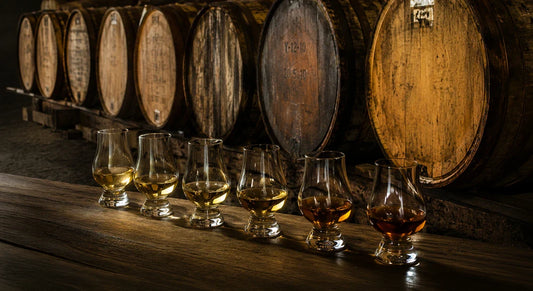
Pour roughly 25 to 30ml and hold the glass up to the light. The colour of a whiskey tells you something about how it was aged and what kind of cask was used.
-
Pale gold or straw: often younger whiskeys or those aged in used casks
-
Deep amber or copper: typically longer aging in active oak, or sherry cask influence
-
Rich mahogany: often heavily sherried Scotch or long-aged expressions
Swirl the glass gently and watch how the liquid moves down the sides. The legs or tears you see indicate viscosity, which is loosely connected to alcohol content and body.
2. Nose
This is where most of the information lives. Before you smell anything, let the glass sit for 30 seconds after pouring. Then bring it slowly to your nose rather than plunging your face in.
Keep your mouth slightly open as you inhale. This prevents the alcohol vapour from overwhelming your olfactory receptors. Take a few short sniffs rather than one long deep one.
What you might find:
-
Fruity notes: apple, pear, banana, dried fruit, citrus zest
-
Grain and cereal: fresh bread, malted barley, porridge oats
-
Floral: heather, honeysuckle, jasmine
-
Spice: black pepper, cinnamon, ginger, clove
-
Oak and wood: vanilla, cedar, toasted oak, smoke
-
Rich and sweet: caramel, toffee, chocolate, honey
-
Savoury: leather, tobacco, dried herbs, meat
Do not worry if you cannot identify everything immediately. The vocabulary of whiskey tasting notes builds gradually with practice. The important thing is to notice what is there and whether it appeals to you.
3. Palate
Take a small sip and let it sit in your mouth for a moment before swallowing. Let it coat your tongue, your gums, and the back of your palate. Notice what arrives first, what develops in the middle, and what lingers.
This is where body and flavour do most of their work, and it is worth understanding what each of those terms actually means.
Understanding Flavour
Flavour in whiskey comes from several overlapping sources:
-
The grain: Bourbon, made primarily from corn, tends toward sweetness and vanilla. Single malt Scotch, made from malted barley, brings a wider range of cereal, fruity, and smoky characters depending on the distillery.
-
The distillation: The shape of the still affects which flavour compounds make it through. Tall stills tend to produce lighter, more delicate spirits. Short, wide stills allow heavier, richer compounds to carry through.
-
The cask: This is arguably the most significant factor in a whiskey's final flavour. Ex-bourbon barrels contribute vanilla, coconut, and light caramel. Sherry casks add dried fruits, chocolate, and Christmas spice. Port casks bring berry fruit. New oak delivers intense vanilla and strong wood tannins.
-
Time: The longer a whiskey spends in cask, the more the spirit interacts with the wood, picking up flavour and colour while also losing some of its harsher edges.
When you taste a whiskey, you are tasting all of these influences at once. Part of the enjoyment is learning to separate them and identify what is coming from where.
Understanding Body
Body refers to the weight and texture of a whiskey on the palate. It is the difference between something that feels light and delicate and something that feels thick, rich, and coating.
Light-bodied whiskeys tend to feel crisp and clean. They are often easier to drink neat and suit people who prefer subtlety over intensity. Many Japanese whiskeys and lighter Highland Scotch expressions fall here.
Medium-bodied whiskeys offer more presence on the palate without feeling heavy. This is where a large proportion of well-made Speyside Scotch and many Irish whiskeys sit.
Full-bodied whiskeys feel substantial and often viscous. They tend to be richer in flavour and more assertive on the palate. Many heavily sherried Scotch expressions, older bourbons, and some Australian whiskeys fall into this category.
Body is influenced by alcohol content, distillation style, and time in cask. It is also one of the clearest indicators of whether a whiskey will suit a particular occasion or preference.
Understanding Finish
The finish is what happens after you swallow. It is the lingering impression the whiskey leaves on your palate, and for many experienced drinkers it is the most telling indicator of quality.
A short finish disappears quickly, leaving little trace of what just happened. This is not necessarily a flaw in an everyday whiskey, but it is rarely a feature of something great.
A medium finish lingers pleasantly for 15 to 30 seconds, offering some development of flavour as it fades.
A long finish stays with you for a minute or more, often evolving as it goes. Spice might build where there was sweetness. Smoke might arrive late. Oak might deepen. The best whiskeys in the world are often distinguished as much by the length and complexity of their finish as by anything that came before it.
Things to look for in a finish:
-
Warmth: a gentle heat from the alcohol that spreads across the chest
-
Dryness or sweetness: which direction does the finish lean as it fades?
-
Spice: does pepper or cinnamon build after swallowing?
-
Smoke: does peat arrive on the finish even if it was quiet on the nose?
-
Oak: do woody, tannic notes emerge as the finish develops?
How to Build Your Tasting Vocabulary
The single best way to develop your palate is to taste regularly and comparatively.
-
Taste two whiskeys side by side from the same region but different distilleries. The contrast will make both more legible.
-
Keep a simple tasting notebook. You do not need elaborate descriptors. Write what you actually notice, even if it is just "smells like Christmas cake" or "tastes a bit like toasted bread."
-
Try the same whiskey with and without water. Notice how it changes. Some whiskeys open dramatically. Others change very little.
-
Explore different styles deliberately. A bourbon, a peated Islay Scotch, a Speyside malt, and an Irish single pot still whiskey will teach you more about flavour variation in a single evening than months of drinking the same bottle.
Frequently Asked Questions
1. Do I need expensive whiskey to learn how to taste properly?
Not at all. Some of the most instructive tasting experiences come from mid-range bottles where the flavour is clear and the style is easy to read. Reserve the expensive bottles for when you have enough context to fully appreciate them.
2. Should I always add water when tasting?
Not always, but try it. Add a single drop first and nose the whiskey again before deciding whether to add more. Many whiskeys above 46% ABV benefit noticeably from a small amount of water.
3. What is the difference between Scotch whisky and bourbon?
Scotch is made in Scotland, predominantly from malted barley, and must be aged for a minimum of three years in oak casks. Bourbon is made in the United States, primarily from corn, and must be aged in new charred American oak barrels. The result is two very different flavour profiles: Scotch tends toward complexity, smoke, and dried fruit, while bourbon leans toward sweetness, vanilla, and caramel.
4. What does peated mean?
Peat is a type of decomposed organic matter used to dry malted barley in certain Scottish distilleries, particularly on the island of Islay. It imparts a smoky, earthy, sometimes medicinal character to the spirit. Whether you love it or find it overwhelming, peated whiskey is one of the most distinctive styles in the world and worth trying at least once.
5. How do I know if a whiskey is good quality?
Balance is the clearest indicator. A well-made whiskey, regardless of price, will have flavour, body, and finish that work together rather than pulling in different directions. Harsh alcohol burn that does not integrate, flavours that feel disconnected, or a finish that is unpleasantly bitter are signs of a whiskey that has not been made or aged with sufficient care.
Tags:
Previous
Single Malt or Blended? Understanding the Two Biggest Whiskey Styles
Next
Top Whisky Brands Every Beginner Should Know
Related articles

Why Does Peated Whisky Taste Smoky?
Sep 09 2026

5 Classic Gin Cocktails to Make at Home
Aug 14 2026


Best Gin for Beginners to Start Your Gin Journey
Jul 29 2026

Best Whisky Distilleries to Visit in 2026
Jul 20 2026